Holiday Grapes

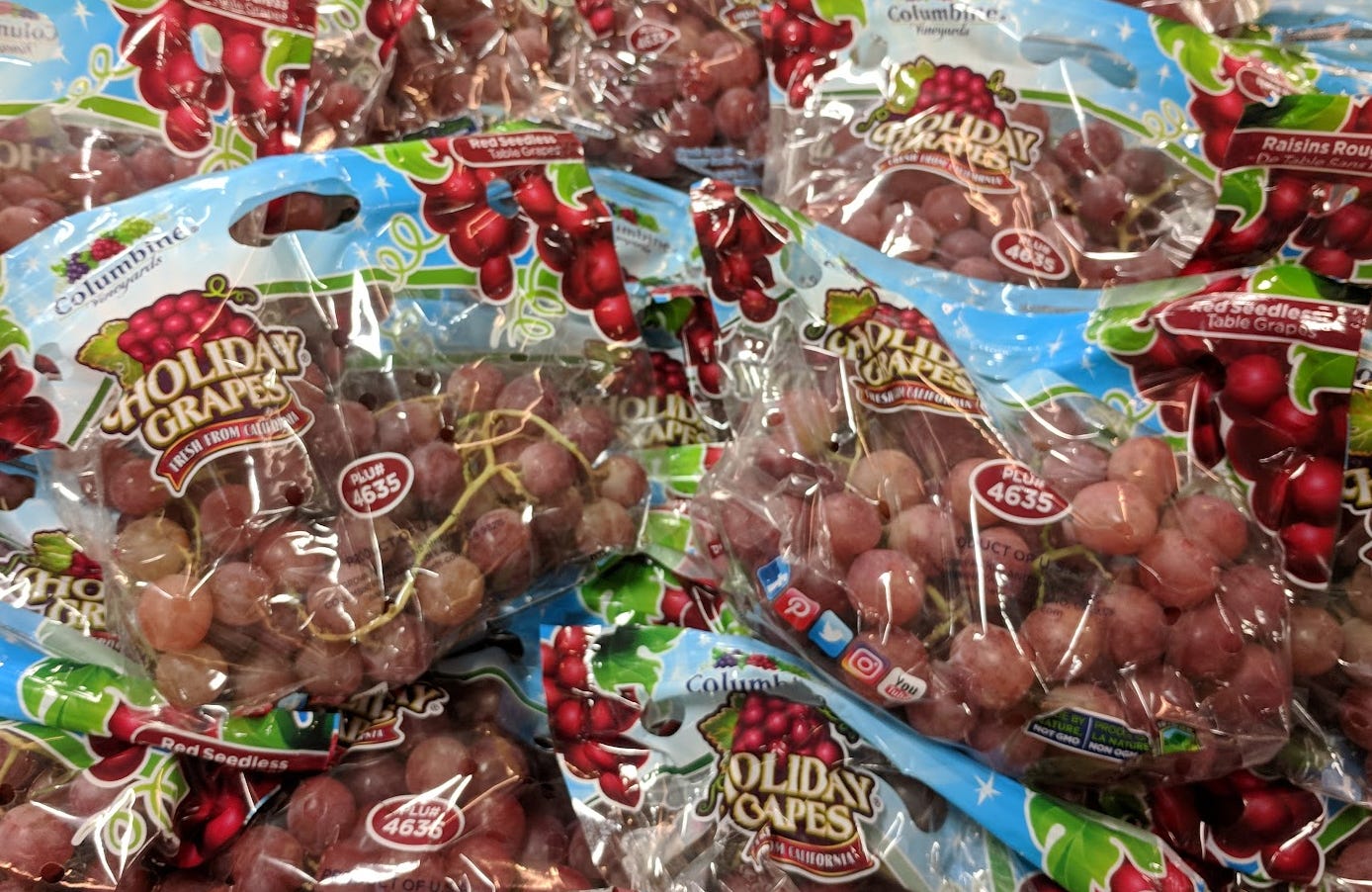
What’s the best natural food in the world? I don’t mean foods like chocolate or pizza that use natural ingredients, but something you can pick, clean, and eat without any preparation. You might think that the “best natural food” is a matter of opinion, but in my opinion, you’re wrong. It’s the Holiday Grape. And if you want to complain that the Holiday Grape isn’t natural because it is the result of human breeding experiments, you should understand that there is hardly anything that we eat that hasn’t been radically altered by human breeding experiments.
People have been cultivating grapes for at least 8,000 years, with evidence found in Türkiye, Armenia, and Iran. Evidence of winemaking is nearly as ancient. The Egyptians and Sumerians wrote about consuming grapes and wine as far back as 5,000 years ago. Grapes have been a part of human life for a very long time.
Grapes and wine were important to the Romans. Table grapes were mostly enjoyed by the wealthy, and eaten fresh when in season (August to October). There are some records of grapes being preserved in honey or vinegar for consumption at other times of the year, but most often they were dried into raisins. Most grapes grown by the Romans went into the production of wine. Watered-down wine was a common drink for even the lower classes. Drinking it undiluted was considered a sign of indulgence or even barbarism. No civilized Roman gentleman would attend a bacchanalia without some lascivious lady hand-feeding him grapes. As the Roman Empire grew and spread across Europe, so did their vineyards. It was the Romans that developed terraced vineyards and many advanced pruning and grafting practices.
In the Middle Ages, grapes were still very important to the Europeans. Because of the key role that wine played in religious ceremonies, viticulture, the study and practice of growing grapes, was largely the domain of monks. They became masters of crossbreeding to improve yields and flavors. They pioneered research into terroir management, which is the focus on the area and conditions in which grapes are grown. And let’s be honest, when a group of people have pledged their lives to celibacy and living in solitude, a certain amount of obsessing over the production and consumption of alcohol is to be expected. Fun fact: in 1205, Pope Innocent III announced that the Church had a method of converting wine into actual human blood, although their process has never been approved by hospitals for blood transfusions.
In the 15th and 16th centuries, Europeans introduced grapes to the New World, in exchange for potatoes and tomatoes. This exchange eventually led to the culinary divide between ‘Potato Europe’ in the north and ‘Tomato Europe’ in the south. This New Zealander tried to unite both groups by developing a plant that grows both potatoes and tomatoes, allowing him to make ketchup and fries from a single plant. But this is an article about grapes, so we’ll ignore the potato/tomato stuff. The important thing is that grapes thrived in the New World, particularly in California and Mexico.
It's a good thing that they did because during the late 19th century a tiny bug called the phylloxera pest almost wiped out vineyards in Europe. The bug fed on the roots of the plants and killed them. The European growers desperately tried everything to save their crops, including flooding the vineyards, using pesticides, and even burying toads in the soil. Nothing worked, not even the toad burying. Salvation came when scientists realized that they could graft their vines onto American rootstocks. That allowed them to keep the desirable characteristics of their local grapes while benefiting from the heartiness of the American roots. The American rootstocks were already resistant to phylloxera. Truth be told, it was probably some American rootstocks brought over to Europe that started the phylloxera plague in the first place, but now they were the solution.
Grafting is the process of joining parts of different plants together into a single Frankenstein plant. In the case of grapes, it is very common to grow roots (rootstock) from a grape with desirable roots and then replace the tops (scion) with parts from a plant that grows better grapes. Fortunately, this was started before Europe developed their modern superstitions about new ideas which has led them to ban deliberate genetic improvements to plants.
If you are a grape fan and a traveler, you’ll notice that almost all table grapes (grapes sold to be eaten as opposed to grapes grown to make wine) are seedless in the US but in Europe most grapes have seeds. Seedless grapes have been around for thousands of years, but aside from being popular in the making of raisins, they didn’t really take off. You don’t want seedless grapes when you are making wine because the seeds provide some of the wine’s flavor and if you make them with seedless grapes wine fans will whine about it. The US grape industry put a larger emphasis on table grapes than did the Europeans and they focus more on innovation. As a result, seedless grape varieties became popular in the US but are still the exception in Europe.
Last year, the United States Department of Agriculture (USDA) celebrated 100 years of contribution to the grape industry. They started with a new table grape cultivar at the USDA Experiment Vineyard in Fresno, California. In 1972, they merged into the USDA’s Agricultural Research Service (ARS). They gave us red seedless “Flame” grapes in 1973. They invented seedless black grapes in 1983. In 2006, they gave us the green seedless “Autumn King” grape. Before 1973, it was almost impossible to get seedless grapes in the US. The next time someone starts waxing poetic about how great things were back in the good old days, remind them that eating grapes (and watermelon) back then was a continuous exercise is spitting out seeds. And while most of the cool new grapes are from California, the ARS is opening a new Grape Genetics Research Unit in Geneva, New York.
The ARS is not the only group working on new grapes. International Fruit Genetics (IFG) is also working on developing new grapes. In 2011, they introduced their masterpiece – the Witch Finger grape. These are elongated black or dark purple grapes that look very different from traditional round grapes. They are very sweet and have a crisp texture, making them one of the only table grapes with a good crunch. In 2016, their marketing department determined that, while the grapes were fantastic, the name was not, so they changed the name to Moon Drop. The IFG also brought us Cotton Candy and Sweet Globe grapes.
Despite the “Genetics” in IFG’s name, these grapes are not GMO grapes. There are no commercial GMO grapes. Despite the incredible things we could probably accomplish with GMO technology applied to grapes, people’s fears and superstitions have discouraged such efforts. That’s not to say that Moon Drops and all other grapes aren’t genetically modified – everything we eat is genetically modified. It’s just that the modifications are done using hybridization and other somewhat random gene-swapping and mutating approaches rather than directly controlling what we are changing.
In the late 1980s, the ARS set about to create a new grape They wanted a red seedless variety that consumers could buy in the fall. They wanted something with large grapes, with a deep red coloration, and extra sweet. They put history’s greatest grape development duo on the job – Dr. David Ramming and Dr. Ron Tarailo.
Dr. Ramming was the mastermind behind the modern seedless grape and is the reason that spitting is no longer a requirement for grape consumption. He led the development of the Flame Seedless, the Crimson Seedless, and later went on to develop the Autumn King, so he was the logical choice to lead the project. He also developed the embryo rescue technique, which has nothing to do with the abortion debate. It’s a method of nurturing grape embryos in a laboratory setting and is the key to the successful development of modern seedless grapes.
Dr. Tarailo focused on breeding grapes resistant to common grape diseases, like powdery mildew. He also worked on improving the adaptability and resilience of grapes. I couldn’t find as much information on him as Dr. Ramming, but I rarely found any reference to Dr. Ramming working on a project without Dr. Tarailo working alongside him, so it isn’t clear who to credit with what. Let’s just say that they were an amazing team that advanced the table grape world more during their career than anyone else in history.
The result of their work in the 1980s and 1990s on their late-season red grape was the Holiday Seedless (marketed as Holiday Grapes). They first hit the market in the early 2000s. Twenty years later, they are still the best grapes in the world. Nothing else is even close.
All Holiday Grapes have been grown by Columbine Vineyards in the San Joaquin Valley. They had the exclusive rights to grow and sell them. Columbine was owned by several generations of the Caratan family and was established back in 1926. In addition to their Holiday Grapes, they also sell Black Globe and Milano grapes. When I contacted the company many years ago, they were very kind and even sent me a gift box with company-branded merchandise. Nice people.
In 2018, Columbine was sold to the investment company AC Foods. In May 2024, AC Foods sold the exclusive rights to grow and market Holiday Grapes to Four Star Fruit. Like Columbine Vineyards, they are a family-owned company also based in the San Joaquin Valley that specializes in the production of table grapes. In fact, they are in the same small town of Delano that Columbine was in. Four Star is very focused on sustainable agriculture and, according to Irrigation Today, they recently became the first Sustainably Grown certified table grapes producer in the United States.
Today, we enjoy an incredible variety of grapes throughout the year. International trade allows grapes to be imported when they aren’t in season locally. The work of brilliant scientists has provided us with juicier, sweeter grapes than our grandparents could have imagined. Seedless grapes are the norm for table grapes throughout the civilized world and are even becoming more common in places like Europe. I can’t wait to see what grapes the future holds, but from a historical perspective, the golden age of the table grape is now. You’ve still got a month or two to find Holiday Grapes at your local grocery. Where I live, you can find them at Whole Foods and Kroger’s. I highly recommend them to anyone who likes grapes. We’re working on a Holiday Grape gelato flavor, but that’s another story for another time.